Horary astrology a yes or no answer from the stars
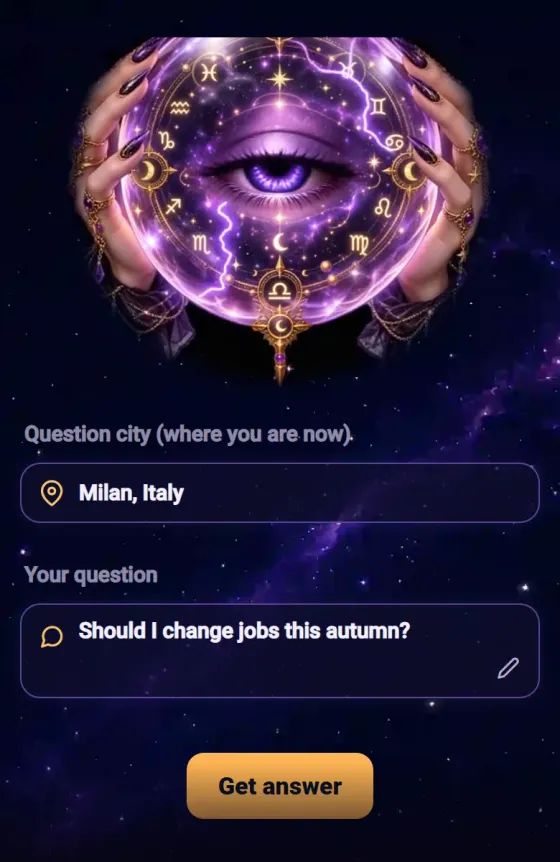
Horary astrology answers one concrete question from a chart cast for the moment you ask it. In the Ask the Oracle section of Oracul you type the question and the city you are in: the app casts the horary chart, judges it by the classical rules and explains the answer in plain words.
What it looks like in the app
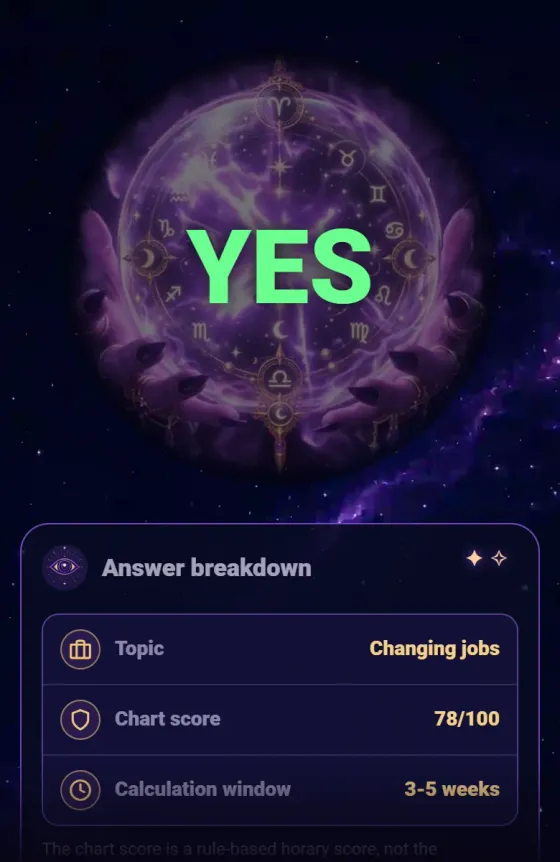
Two screens of the Ask the Oracle section: the question and the answer.
What is horary astrology
Horary astrology (from the Latin hora, “hour”) is one of the oldest branches of astrology. Instead of a birth chart, the astrologer casts a chart for the moment a question is asked and for the place where the person asking is. The idea is simple: the sky at the moment a question arises holds its answer.
In that chart the person asking is shown by the 1st house, the Ascendant and its ruling planet, together with the Moon. The matter of the question is shown by the house that rules it and by the ruler of that house. The answer depends on whether these significators come together: an applying aspect between them points to “yes”, a blocked or missing contact points to “no”.
Which house answers which question
- 1st house — you, the person asking;
- 2nd house — money, income, possessions and purchases;
- 4th house — home, property, moving house and family roots;
- 5th house — love affairs, dating, children and pregnancy;
- 7th house — partner, marriage, contracts and the other person;
- 10th house — career, job, promotion and reputation.
Questions about another person turn the chart: their houses are counted from the house that represents them. Your partner's job, for example, is the 10th house counted from the 7th, which is the 4th house of the chart.
How Oracul answers your question
Ask one concrete question
Write a question that can be answered with yes or no: “Will I get this job?”, “Should I sign the contract?”, “Will he call me back?”.
Enter the city where you are
Horary astrology uses the moment and the place of the question, not your birth data. The app takes the current time and the city you choose; if you leave the city empty, it uses your birth place.
The app finds the topic and its house
AI reads the question and names its topic: what it is about and who it concerns. Then the astrological engine, not the AI, picks the houses and the significators for you and for the matter of the question.
The chart is judged by the classical rules
The engine checks whether the two significators are applying to an aspect (perfection) or meet through a third planet (collection of light), and whether another planet gets in the way (prohibition). It also weighs reception, combustion, retrograde motion and a void-of-course Moon, then gives the verdict and the chart score.
What you get in the answer
The crystal ball shows the verdict, and under it come the Answer breakdown and the explanation:
- Yes or no in the crystal ball — the verdict of the chart;
- Topic — what the app understood your question to be about;
- Chart score from 0 to 100 — how clearly the chart answers by the rules of horary astrology;
- Calculation window — roughly when the matter may resolve, counted from the degrees left until the aspect is exact;
- In plain words — the meaning of the answer, an advice and a note on timing;
- Why this answer and What blocks it — the astrological arguments for and against.
The chart score is a rule-based horary score, not the probability that the answer will come true.
How to ask a good horary question
- One question at a time: “Will I get this job?” rather than “What awaits me at work and in love?”;
- Ask about what really matters to you now, not out of idle curiosity;
- Do not ask the same question again until the situation has changed: the first chart is the one that counts;
- Name the thing precisely and, if it matters, the time frame: “Will I sell the car before summer?”.
Horary chart, natal chart and horoscope
A natal chart describes a person: it is cast once, for the moment of birth, and never changes. A daily horoscope describes the general weather of the sky for a sign. A horary chart describes a single question: it is cast for the moment you ask, so it needs neither your birth time nor your sign.
Astrology describes symbolic tendencies, not guaranteed events. Take the answer as one more point of view and make decisions with your own judgement, especially about health, money and legal matters.
Questions about horary astrology
What is a horary chart?
It is an astrological chart cast for the moment and the place a question is asked. Its planets describe the person asking, the matter of the question and the link between the two, which gives a yes or no answer.
Do I need my birth time?
No. Horary astrology does not use your natal chart: everything comes from the time and place of the question. You only type the question and choose the city where you are.
Can I ask about another person?
Yes: about a partner, a child, a relative or a friend. The app recognises who the question is about and counts the houses from that person's house, as classical horary astrology does.
How reliable is the answer?
The chart score shows how clearly the chart answers by the rules of horary astrology, not the probability that the answer will come true. A low score means the sky gives no clear signal: the situation may still be undecided.
Is horary astrology free in Oracul?
No. You can open the section and type your question, but the answer itself is part of the Oracul subscription — monthly, every three months or yearly. You subscribe and cancel through Google Play, and the exact price in your currency is shown in the app before you pay.

Ask your question in Oracul
Horary answers, together with the natal chart, Tarot and daily forecasts, are in the Oracul app for Android.
- Yes or no
- Chart score
- Timing